

- Drawer Dimensions
x
- Height & bottom
- Insert Dimensions
- Template Name
- Fixed Walls Set
- Movable Dividers
Choose a Height & Bottom Option
Height
The height of your insert is the height of the usable storage you'll have in your insert.
Bottom Options
Your choice of bottom-type will affect your insert's overall height.
| Bottom Type | Additional Height |
|---|---|
| No bottom | 0" |
| Wood bottom | less than 0.25" |
Choose a Height
More about Height and Bottom Options
Should I get an attached bottom?
We recommend that there be some protective material between your utensils and your drawer bottom. It could be a rubber or plastic mat, a thin layer of cork, or an attached bottom on your drawer insert. Some people find it easier to clean bottomless inserts.
There are some instances in which we recommend attached bottoms.
- If your drawer bottom is bowed or large and prone to bow/sag when under a load, adding an attached bottom is a good idea. Otherwise, you'll likely have gaps under parts of your inserts. Utensils would then be able to slip underneath the insert. Check to see if your drawer bottom is bowed by using a tight string or a straight edge to test it.
- Consider what you will be storing in your drawer organizer. Thin and/or very pointy utensils can be prone to getting wedged underneath a wall and/or movable divider. If you will be storing these types of items, an attached bottom can help.
Can I make the insert taller than the drawer box?
Example: your drawer box is 1.75" tall, but you are wanting a 2" tall drawer insert. Can that be done?
The real limit of your insert's height is not the height of your drawer, but rather the clearance to the cabinet frame above the drawer. All drawers have some clearance above the drawer box. There is no standard clearance in the cabinet industry: some are small, others are considerable. Measure from the drawer bottom to the nearest obstruction to see if the insert will fit in your drawer; don't forget to check all the way back into the interior of the cabinet body. We recommend leaving at least .25" of clearance between the top of your insert and the obstruction above.
Below is an example of an insert that is taller than the drawer box.
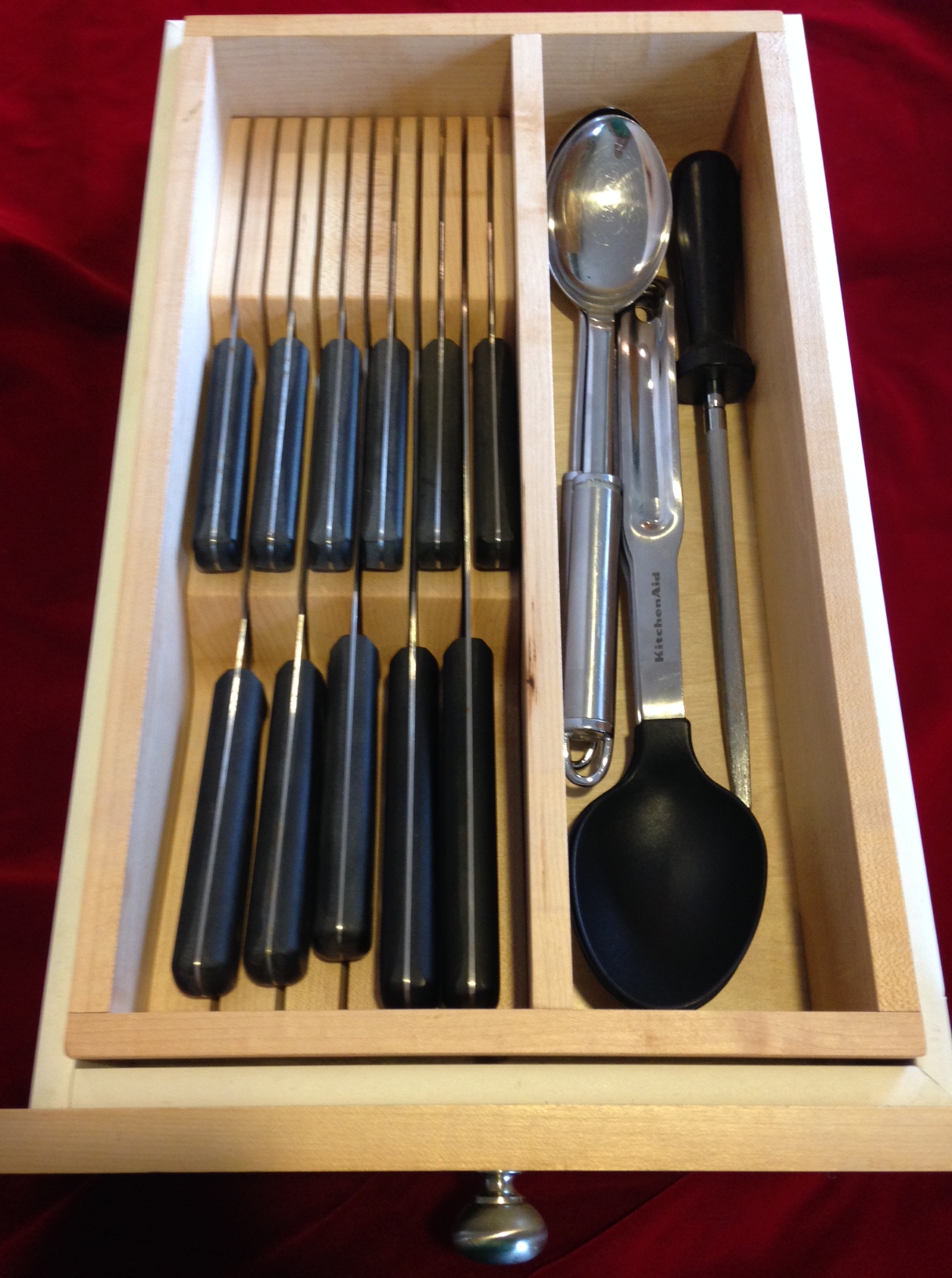
What are the wedges/shims I see in some of your pictures?
We ship small wedges with every bottomless custom insert. Use the wedges in the space between the sides of your drawer and the corners of the insert. The wedges will help pin the insert to the drawer's bottom, decreasing instances of utensils creeping under the insert's walls or dividers.